Mostrando entradas con la etiqueta literatura. Mostrar todas las entradas

miércoles, 4 de abril de 2018

Dylan Thomas vía Spotify

Vía
Un fragmento de Ballad of the Long-Legged Bait (vía) 

Funnels and masts went by in a whirl. 
Good-bye to the man on the sea-legged deck 
To the gold gut that sings on his reel 
To the bait that stalked out of the sack, 

For we saw him throw to the swift flood 
A girl alive with his hooks through her lips; 
All the fishes were rayed in blood, 
Said the dwindling ships.

El poema completo--recitado por Thomas--vía Spotify:

martes, 30 de enero de 2018

Un fragmento de The Perennial Philosophy (Huxley, 1944)

Todavía la nieve me parece bonita
The mind is on fire, thoughts are on fire. Mind-conscious-
ness and the impressions received by the mind, and the
sensations that arise from the impressions that the mind
receives--these too are on fire.
  And with what are they on fire? With the fire of greed,
with the fire of resentment, with the fire of infatuation; 
with birth, old age and death, with sorrow and lamenta-
tion, with misery and grief and despair they are on fire.

                                        From the Buddha's Fire Sermon
                                      p. 178; vía Ed. Harper Colophon, 1970.

domingo, 28 de enero de 2018

The Last Question (audio, vía YouTube)

Vía
It all had a beginning in the original cosmic explosion, whatever that was, and it'll all have an end when all the stars run down. Some run down faster than others. Hell, the giants won't last a hundred million years. The sun will last ten billion years and maybe the dwarfs will last two hundred billion for all the good they are. But just give us a trillion years and everything will be dark. Entropy has to increase to maximum, that's all.

martes, 6 de junio de 2017

Sharkey's Night (Laurie Anderson/William S. Burroughs)

Abe Frajndlich 1984/2013 (vía)
Sun's going down. Like a big bald head.
Disappearing behind the boulevard. (Oooeee.) It's Sharkey's night.
Yeah. It's Sharkey's night tonight. And the manager says: Sharkey?
He's not at his desk right now. (Oh yeah.) Could I take a message?

And Sharkey says: Hey, kemosabe! Long time no see.
He says: Hey sport. You connect the dots. You pick up the pieces.
He says: You know, I can see two tiny pictures of myself
And there's one in each of you eyes. And they're doin' everything I do.
Every time I light a cigarette, they light up theirs.
I take a drink and I look in and they're drinkin' too.
It's drivin' me crazy. It's drivin' me nuts.

And Sharkey says: Deep in the heart of darkest America.
Home of the brave. He says: Listen to my heart beat.
Paging Mr. Sharkey. White courtesy telephone please.*

*Lyrics vía

jueves, 1 de junio de 2017

Un poema de El universo de cosas con que quedarnos (Guillermo Rebollo-Gil, 2017)

Se compra aquí
Crónica de no soy el único*

Soy freak de las edades de muerto de mis héroes. A manera
de ejemplo, cumplo 36 el año próximo--la edad que tenían
Alejandra Pizarnik y Bob Marley cuando murieron. Mis 
40 serán de Frank O'Hara. Los 46 de David Foster Wallace,
Héctor Lavoe y ahora Phillip Seymour Hoffman. Maelo
murió con 55. Cuando mataron a Tupac Shakur, a sus 25
años, Quincy Jones dijo:

"The tragedy of Tupac is that his untimely passing is
representative of too many young black men in this country....
If we had lost Oprah Winfrey at 25, we would have lost a 
relatively unknown, local market TV anchorwoman. If we 
had lost Malcom X at 25, we would have lost a hustler named 
Detroit Red. And If I had left the world at 25, we would have 
lost a big-band trumpet player and aspiring composer--just a
sliver of my eventual life potential."

Con dos años más, Tupac hubiera muerto demasiado
temprano, junto a Jimi, Janis y compañía. Ante la muerte de
Hoffman--quien tuvo dos décadas de vida más que Tupac,
una más que Pizarnik y Marley, y seis años más que O'Hara--
siento que veinte años hacen que uno haga las paces con
la vida en tanto y en cuanto, con el tiempo, aprende a
reconocer que ella te ha hecho posible conocer las obras, los
prayoectos y haceres de gente talentosa y bella. Pero entonces
la muy sucia te los quita y uno comienza a desear no haber
llegado a la edad de Jimi, de Janis y compañía. De momento,
llegar a tener la edad de Maelo se torna en algo descabellado.
Creul.

A mí me gustaba cuando Hoffman se rascaba la cabeza y
cuando sus personajes pasaban trabajo para decir algo que
supone ser muy fácil de articular pero que a la mayoría
nos cuesta hacerlo. En eso consiste el arte, supongo--en
diminutos actos de solidaridad, seguidos de algo maravilloso.
La vida es el opuesto al arte. Consiste en diminutas pérdidas,
seguidas de una más grande. 

*Aparece en pp. 25-26 de El universo de cosas con que quedarnos;
Publicado por Ed. Disonante, 2017. 

jueves, 25 de mayo de 2017

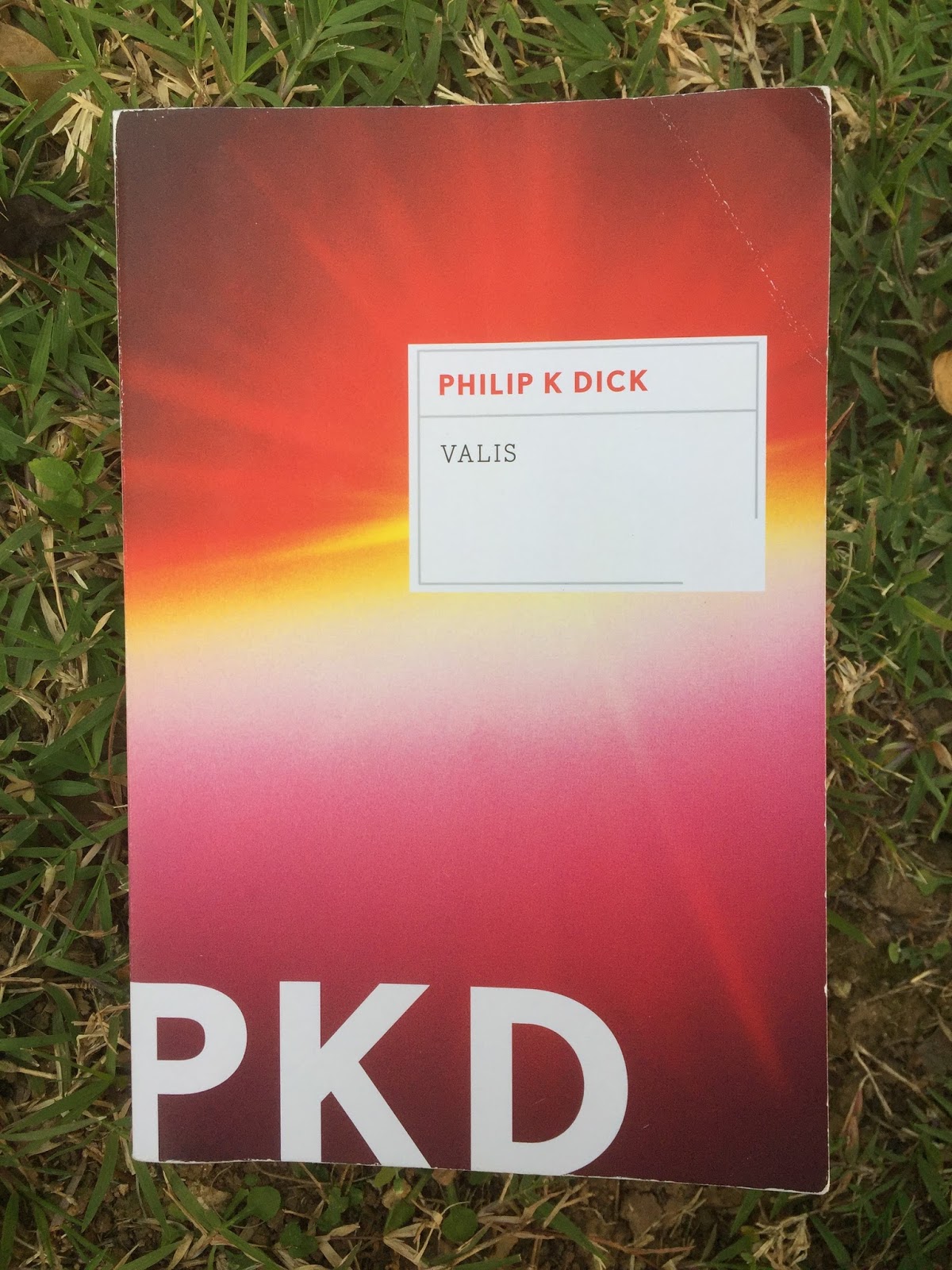
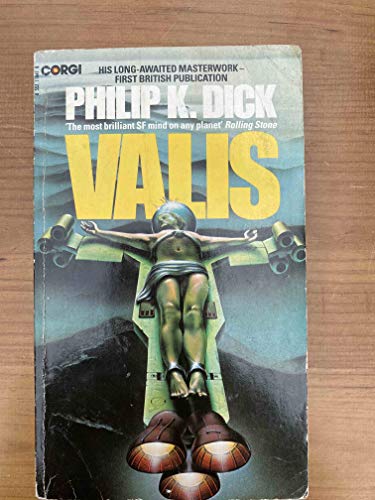
Fragmentos de Valis (PKD, 1981)

"The Empire never ended"
"12) The Immortal One was known to the Greeks as
Dionysos; to the Jews as Elijah; to the Christians as
Jesus. He moves on when each human host dies,
and thus is never killed or caught. Hence Jesus on
the cross said, "Eli, Eli, lama Sabachthani," to which 
some of the present correctly said, "The man is
calling on Elijah," Elijah had left him and he died alone." 
(Tractates: Criptica Scriptura, p. 258);

"[T]wo new propositions
     1) Some of those in power are insane
     2) And they are right." (p. 65);

"[T]he cosmos as a sentient 
entelechy with psyche and soma,
a macrocosmic mirror to man
the microcosm." (p. 92);

"My dear people, we are already 
the Children of God but what
are we to be in the future
has not yet been revealed;
all we know is that we 
shall be like him because
we shall see him as he really is." 
(I John 3:1/2, p.69);

"Its upper part is not dazzling;
Its lower part is not obscure.
Dimly visible, it cannot be named
And returns to that which is without substance.
This is called the shape that has no shape,
The image that has no substance.
This is called indistinct and shadowy.
Go up to it and you will not see its head,
Follow behind it and you will not see its rear."
(Tao Te Ching, por Lao Tzu, p. 59).                                             

viernes, 5 de mayo de 2017

Latin@ Rising, una antología de ci fi y fantasía latina

Disponible aquí y en Librería La Tertulia (VSJ)
Science fiction and fantasy are uniquely able to deal with the expressions of migration in that they are generally dependent on the existence of at least two worlds, and it is immigration that puts these worlds in contact. Science fiction theorist Darko Suvin observes that it is "a voyage to a new locus" that creates the novum (the new element) of a science fiction story (71). And while the relationship between migration and the genres is important in understanding what is going on in Latin@ science fiction and fantasy, readers will find a host of themes in this anthology. A number of the stories are politically oriented while some would be better described as psychological tales. Some focus on community-specific issues while some have nothing that could be identified as specifically Latin@. All are excellent stories that maintain the wonder and astonishment that only science fiction and fantasy can offer. Punto.*

*Matthew David Goodwin, editor de la antología. 

miércoles, 3 de mayo de 2017

The Eye (Nabokov, 1930)

Primera edición en inglés
     Matilda, a friend of their parents, often vis-
ited them and stayed for dinner. One night,
as she was leaving, and there was a noisy
downpour, they lent her an umbrella, and she 
said: "How nice, thank you very much, the
young man will see me home and bring it
back." From that time on, walking her home
was one of my duties. I suppose she rather 
appealed to me, this plump, uninhibited, cow-
eyed lady with her large mouth, which would
gather into a crimson pucker, a would-be rose-
bud, when she looked in her pocket mirror to
powder her face. She had slender ankles and 
a graceful gait, which made up for many 
things. She exuded a generous warmth; as soon
as she appeared, I would have the feeling that
the heat in the room had been turned up, and 
when, after disposing of this large live furnace
by seeing her home, I would be walking back
alone amid the liquid sounds and quicksilver
gloss of the pitiless night, I would feel cold,
cold to the point of nausea. 

Tomado de las páginas 4 & 5 de The Eye (Nabokov, 1930; Ed. Vintage International)
Traducido por Dimitry Nabokov, en colaboración con el autor. 

sábado, 21 de enero de 2017

Fragmento de un cuento de Luis Negrón

"[] El pastor me miró con aquellos ojos de profe- 
ta que sabía poner bien. Lo vi mirarme con rabia. 
Vi su cuerpo moreno y macizo a través de su ropa 
blanca mojada. Vi los pelos de sus brazos moja- 
dos, cerca de su piel. Vi que veía que yo veía lo 
que veía. Vi, a través de sus pantalones blancos, 
cómo dentro del calzoncillo blanco y de algodón, 
se le abultaba aquello. Vi a los hermanos en la 
orilla embelesados por mi belleza, mirándome. 
Vi la cara de Papi a lo lejos, mirándome mirar. 
Este muchacho es un monstruo, decía su rostro. 
Vi a mami mirar mi monstruosidad en el rostro 
de Papi. Les di la espalda a mi padre y a mi ma- 
dre y miré de nuevo aquello que ya se encorvaba 
sobre el muslo del pastor cuando me zambulló en 
el agua."

[] Aparece en El elegido, páginas 30 & 31 de Mundo Cruel. 
Las negritas del texto son mías.